
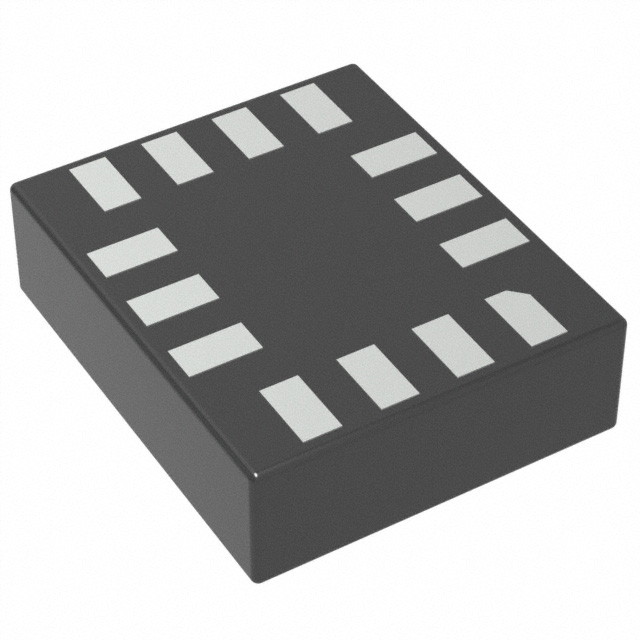
The LSM6DSRTR chip combines a 3-axis accelerometer and a 3-axis gyroscope into a single compact module. It enables precise motion tracking by measuring acceleration and angular velocity across multiple axes. This makes it ideal for applications requiring accurate movement detection.
You might wonder why the LSM6DSRTR stands out among motion tracking chips. Its advanced features, such as low power consumption, embedded motion processing, and wide measurement ranges, make it a top choice. The table below highlights its key technical advantages:
Feature | Description |
|---|---|
Integrated Sensors | 3-axis accelerometer and 3-axis gyroscope |
Measurement Ranges | Up to ±16g (accelerometer) and ±2000 dps (gyroscope) |
Power Consumption | High-performance, low-power, and low-noise sensors |
Embedded Features | Advanced motion processing and power management |
Operating Voltage | 1.71V to 3.6V |
Data Interfaces | I2C and SPI digital interfaces |
FIFO Buffering | Embedded FIFO for sensor data buffering |
Compact Design | Low-power design suitable for space-constrained applications |
Temperature Range | Wide operating temperature range |
Compliance | RoHS3 compliant |
With these features, the LSM6DSRTR delivers reliable performance for motion tracking in various fields, from robotics to consumer electronics.
Key Takeaways
The LSM6DSRTR has a 3-axis accelerometer and 3-axis gyroscope. It tracks motion accurately in different directions.
It uses little power and is small, perfect for battery devices and tight spaces.
To work well, connect it properly and set up the software right. Follow the setup steps carefully.
Calibrating the sensor makes it more accurate. Do both still and moving tests for better results.
The LSM6DSRTR works in many areas like gadgets, robots, and healthcare. It helps create new ideas and solutions.
Understanding the LSM6DSRTR
Key Features of the LSM6DSRTR
The LSM6DSRTR stands out as a versatile 6-axis sensor module. It combines a 3d accelerometer and a 3d gyroscope, enabling precise motion tracking across multiple axes. This compact module also includes a temperature sensor, ensuring reliable performance in various environments. Its high accuracy and low power consumption make it ideal for battery-operated devices.
Here are some of its key features:
6-axis measurement, including accelerometer, gyroscope, and temperature sensing.
High accuracy and reliability for precise motion detection.
Compact design, perfect for space-constrained applications.
I2C and SPI output interfaces for seamless integration.
Applications in consumer electronics, wearables, and industrial automation.
These features make the LSM6DSRTR a preferred choice for inertial motion tracking in diverse fields.
Technical Specifications
The LSM6DSRTR offers impressive technical specifications that cater to a wide range of motion tracking needs. Below is a detailed overview:
Parameter | Specification |
|---|---|
Accelerometer range | ±2g/±4g/±8g/±16g |
Gyroscope range | ±125 dps/±250 dps/±500 dps/±1000 dps/±2000 dps |
Accelerometer sensitivity | 0.061 mg/LSB to 0.488 mg/LSB |
Gyroscope sensitivity | 4.375 mdps/LSB to 70 mdps/LSB |
Power consumption | Low power consumption, varies by mode |
These specifications highlight the module’s adaptability and precision, making it suitable for applications requiring accurate motion sensing.
Benefits for Motion Tracking
The LSM6DSRTR delivers several benefits for motion tracking. Its integrated 3d accelerometer and gyroscope provide seamless measurement of linear acceleration and angular velocity. This ensures accurate tracking of movement and orientation. The module’s low power consumption extends battery life, which is crucial for portable devices.
You can rely on its high accuracy and advanced motion processing capabilities to achieve precise results. Whether you’re working on robotics, wearables, or industrial systems, the LSM6DSRTR ensures reliable performance. Its compact design also simplifies integration into your projects, saving both time and space.
By leveraging the LSM6DSRTR, you can unlock new possibilities in motion tracking and create innovative solutions for various industries.
Setting Up the LSM6DSRTR for Motion Tracking
Hardware Connections
To set up the LSM6DSRTR for motion tracking, start by ensuring proper hardware connections. The sensor requires secure wiring to function correctly. Follow these steps to connect it to your microcontroller:
Connect the power and ground pins of the LSM6DSRTR to the corresponding pins on your microcontroller. Verify that the voltage matches the sensor’s requirements (1.71V to 3.6V).
For I2C communication, link the SDA and SCL pins of the sensor to the respective pins on your microcontroller. If using SPI, connect the MOSI, MISO, and SCK pins instead.
Double-check all connections to avoid loose wires or incorrect placements.
Common challenges during hardware setup include improper communication settings and incorrect power supply. To resolve these, ensure the wiring is accurate and the voltage levels are correct. Misinterpretation of sensor data can also occur, so verify the communication configuration for reliable operation.
Software Configuration
Once the hardware is ready, configure the software to initialize and operate the LSM6DSRTR. Use the following tools and libraries to simplify the process:
Software Tools/Libraries | Description |
|---|---|
Device Drivers | Essential for sensor communication and initialization. |
Configuration Libraries | Help in setting up the sensor for specific applications. |
Example Code | Provides practical implementations for platforms like STM32, Arduino, and Raspberry Pi. |
Sensor Fusion Libraries | Enable advanced features like sensor fusion algorithms for motion tracking. |
Start by loading the appropriate device drivers for your platform. Use configuration libraries to set the sensor’s parameters, such as measurement ranges for the accelerometer and gyroscope. Example code can guide you through the process, especially if you’re using popular platforms like Arduino. For advanced applications, sensor fusion libraries can enhance motion tracking accuracy.
Testing and Verifying the Setup
Testing ensures that your LSM6DSRTR setup works as intended. Begin by calibrating the sensor to achieve accurate measurements. Calibrate the accelerometer and gyroscope individually to correct offset and scale factor errors. Perform static tests by positioning the sensor at known angles and dynamic tests by rotating it.
Follow these best practices during testing:
Verify communication settings to avoid data misinterpretation.
Confirm that the power supply connections are stable.
Adjust the sensor’s internal registers for fine-tuning measurements.
Many microcontroller platforms, such as STM32, offer software libraries to assist with calibration. Always adhere to the manufacturer’s recommendations for optimal performance. Proper testing ensures that your motion tracking system delivers reliable results, whether you’re building motion capture suits or robotics applications.
Applications of the LSM6DSRTR in Motion Trackers
Consumer Electronics
The LSM6DSRTR plays a vital role in consumer electronics, especially in devices like smartphones and wearables. Its 6-axis inertial sensor module combines a 3-axis accelerometer and a 3-axis gyroscope, enabling accurate motion tracking. This makes it ideal for measuring physical parameters such as acceleration and angular velocity.
In wearable devices, the sensor supports activity tracking, step counting, and motion sensing. For smartphones, it enhances user interaction by enabling features like screen orientation, shake detection, and motion-based controls. Additionally, gaming devices use the LSM6DSRTR for gesture control and immersive experiences.
Application Type | Description |
|---|---|
Wearable devices | Used for activity tracking, step counting, and motion sensing. |
Smartphones | Utilized for screen orientation, shake detection, and motion-based interaction. |
Gaming | Employed for gesture control and immersive user experiences. |
These applications highlight the sensor’s versatility and its ability to track the movement of users in real-time.
Robotics and Automation
In robotics, the LSM6DSRTR ensures precise motion tracking and control. Its accelerometer and gyroscope work together to provide accurate data on movement and orientation. This makes it indispensable for applications requiring stability and navigation.
Robots equipped with this sensor can perform tasks with high precision. For example, it aids in motion control, ensuring smooth and accurate movements. It also supports stabilization, which is crucial for maintaining balance in dynamic environments. The sensor’s reliability makes it a key component in automation systems, where consistent performance is essential.
By integrating the LSM6DSRTR, you can enhance the capabilities of robotic systems, enabling them to operate efficiently in complex scenarios.
Industrial and Healthcare
The LSM6DSRTR finds significant use in industrial and healthcare applications. In industrial systems, it monitors vibrations and tracks the condition of machinery. This helps in predictive maintenance, reducing downtime and improving efficiency. For automation, the sensor supports motion monitoring and control, ensuring smooth operations.
In healthcare, the sensor is used in devices for activity tracking and rehabilitation. It enables accurate monitoring of patient movements, aiding in recovery and therapy.
Application Area | Specific Use Case |
|---|---|
Industrial systems | Vibration monitoring and machinery condition monitoring |
Healthcare Devices | Activity tracking and rehabilitation |
These applications demonstrate the sensor’s ability to deliver reliable motion tracking in critical environments.
Troubleshooting and Optimizing Motion Tracking
Common Issues and Solutions
When using the LSM6DSRTR for motion tracking, you may encounter some common issues. Addressing these problems ensures reliable performance:
Improper communication settings can disrupt data transmission. Verify the I2C or SPI configuration matches the sensor’s requirements.
Incorrect power supply can lead to unstable operation. Ensure the voltage falls within the recommended range of 1.71V to 3.6V.
Misinterpretation of sensor data often results from incorrect calibration. Use software libraries to fine-tune the accelerometer and gyroscope readings.
Excessive vibrations can affect accuracy. Consider mounting the sensor on a vibration-dampening platform or using models designed for high-vibration environments.
By resolving these issues, you can optimize the sensor’s performance and achieve accurate motion tracking.
Best Practices for Accurate Motion Tracking
To achieve precise results, follow these best practices:
Calibrate the Sensor: Calibration is essential for correcting offset and scale factor errors. Perform static tests by positioning the sensor at known angles and dynamic tests by rotating it. Many platforms, like STM32, offer libraries to simplify this process.
Secure Installation: Connect the power supply, communication lines, and control signals according to the datasheet. Proper installation ensures stable operation.
Implement Data Processing Algorithms: Use advanced algorithms to interpret motion data accurately. These algorithms enhance the sensor’s ability to track someone’s body movements or track your head movements in real-time.
Adjust Internal Registers: Fine-tune the sensor’s internal settings based on the manufacturer’s recommendations for optimal performance.
These steps help you unlock the full potential of the LSM6DSRTR for tracking the motion of objects or individuals.
Additional Resources for Learning
To expand your knowledge of the LSM6DSRTR and its applications, explore these resources:
Wearable Devices: Learn how the sensor supports activity tracking, step counting, and motion sensing.
Smartphones: Discover its role in screen orientation, shake detection, and motion-based interaction.
Gaming: Understand how it enables advanced facial tracking and gesture control for immersive experiences.
Industrial Systems: Study its use in vibration monitoring and machinery condition tracking.
Robotics: Explore its applications in precise motion control and stabilization.
Healthcare Devices: Learn about its role in activity tracking and rehabilitation.
These resources provide valuable insights into the sensor’s versatility across various fields.
The LSM6DSRTR offers a powerful combination of a 3-axis accelerometer and a 3-axis gyroscope, delivering precise motion tracking with low power consumption. Its compact design and advanced features make it suitable for a wide range of applications, from wearable devices to industrial automation. You can rely on its high accuracy and seamless integration to create innovative solutions.
If you’re looking for project ideas, consider these applications:
Application Type | Description |
|---|---|
Inertial Measurement Units (IMUs) | Used for motion sensing and tracking. |
Wearable Devices | Ideal for fitness trackers and smartwatches. |
Robotics | Applications in accurate motion control and navigation. |
Industrial Automation | Used for motion monitoring and control. |
IoT Sensors | Integrated for environmental monitoring and gesture recognition. |
Healthcare Devices | Applications in activity tracking and rehabilitation. |
Experimenting with the LSM6DSRTR opens up endless possibilities. Whether you’re building a fitness tracker or a robotic navigation system, this chip empowers you to bring your ideas to life. Explore its capabilities and start creating today!
FAQ
What makes the LSM6DSRTR ideal for motion tracking?
The LSM6DSRTR combines a 3-axis accelerometer and a 3-axis gyroscope in one compact module. It offers high accuracy, low power consumption, and advanced motion processing. These features make it perfect for applications like robotics, wearables, and industrial automation.
How do you connect the LSM6DSRTR to a microcontroller?
You can connect the LSM6DSRTR using I2C or SPI interfaces. Link the power, ground, and communication pins to the corresponding microcontroller pins. Ensure the voltage matches the sensor’s requirements (1.71V to 3.6V) for stable operation.
Can the LSM6DSRTR be used with Arduino?
Yes, the LSM6DSRTR works seamlessly with Arduino. Use compatible libraries to configure the sensor and read data. Example codes are available to help you set up and test the sensor for motion tracking projects.
What applications benefit from the LSM6DSRTR?
The LSM6DSRTR is versatile. It supports wearable devices for activity tracking, robotics for motion control, and industrial systems for vibration monitoring. It also enhances gaming devices with gesture control and immersive experiences.
How do you calibrate the LSM6DSRTR for accurate results?
Calibrate the accelerometer and gyroscope using static and dynamic tests. Adjust the sensor’s internal registers to correct offset and scale errors. Many platforms, like STM32, provide libraries to simplify the calibration process.
See Also
Discovering ADI’s Remarkable ADXRS453BRGZ Motion Sensor Technology
Unveiling the Low Power Features of ADXL357BEZ Accelerometer
Exploring Applications of STM8S003F3P6TR in Embedded Systems